
Welcome to the
City of Nicholasville!
Where we share the good life.
- Home
- Stormwater
Stormwater
Stormwater Management & Protection

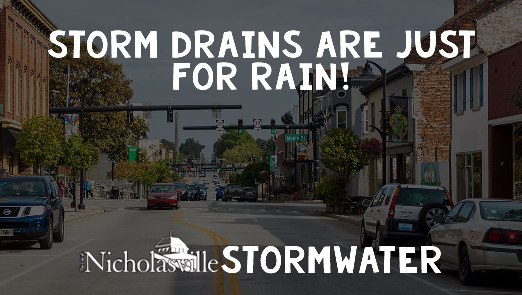
People don’t often think about their community’s stormwater system – the pipes and ditches that carry rain and other liquids away from homes and businesses. That is, until it doesn’t work properly and water backs up on their streets and property.
Water that enters the stormwater drainage system is not treated like the sanitary sewer, which removes and treats the water that is generated in kitchens and bathrooms. Dirt and organic materials (grass clippings and leaves, motor oil, gasoline, antifreeze and other poisons) enter the stormwater system every day and flow directly into lakes, streams and rivers.
Stormwater Runoff
Spring Cleaning
Stormwater Runoff
Stormwater runoff has become a significant cause (about 40%) of our nation’s water pollution. Federal regulations now require cities to take steps to reduce the problem. Voluntary compliance is being sought because communities that fail to do so will have to implement ordinances that carry punishment, such as fines.
Following are 10 steps that can have an impact on improving stormwater:
- Don’t dump anything down storm drains, particularly oils, poisons, soaps, etc.
- Use pesticides and fertilizers sparingly.
- Put litter in its place (trash and recycling cans).
- Pick up after your pet.
- Sweep driveways (don’t spray wash).
- Collect yard waste and keep it out of storm drains.
- Use a car wash (they recycle spray wash) or wash vehicles on grassy areas.
- Recycle used motor oil.
- Check your car for leaks (and fix them).
- Have your septic tank inspected every 3 – 5 years.
The City requests that citizens compost or bag their fallen leaves and other yard waste rather than raking them into piles at the curb, since they are often swept into the stormwater system by rain and wind.
Please contact City Hall if you witness anyone dumping any materials other than water into a drainage structure and provide information about the incident, including the address. A courtesy letter will be sent to inform the offender of the harm such actions cause and requesting this not be done in the future. For more information about stormwater issues, visit the Environmental Protection Agency’s website.
Spring Cleaning
As warm weather comes we start back to many outdoor activities that Spring invites. One of those activities is the ability to wash our own cars. Much attention has been raised on the internet about the crackdown on washing cars in our own driveways. Let’s look at this from a water issue. The average at-home wash uses about 150 gallons of water while a typical automatic car wash uses anywhere from 50 to as little as 15 gallons of water for the same (or better) wash. Multiply that by the many thousands of household car washes each year and water savings from the local car wash become clear.
From a water quality standpoint, washing a car in your driveway can have similarly negative impacts. The rinse water that runs off your driveway will flow into a storm sewer and, in most cases, directly to a stream. That rinse water contains the soaps used in washing with high levels of phosphates. These can contribute too many nutrients to local waters and cause algae growth. Brake dust and oils are also washed off of cars, which can contain heavy metals including lead.
Conversely, almost all car washes are now required to extensively filter (and sometimes recycle) the water that is used in the washing process.
Take Action
- Find your car wash
- If you are going to wash at home, buy eco-friendly car soap from sites such as Amazon or local automobile parts stores.
Stormwater Education & Awareness
Contact Details
| Brian Claar |
| City Engineer |
| 517 N. Main Street, Nicholasville, KY 40356 |
| 859.885-1121 Ext. 256 |
| brian.claar@NicholasvilleKY.gov |
| Doug Blackford |
| Director of General Government |
| 517 N. Main Street, Nicholasville, KY 40356 |
| 859.885-1121 |
| doug.blackford@NicholasvilleKY.gov |
| David Brown |
| Superintendent, Nicholasville Public Works |
| 517 N. Main Street, Nicholasville, KY 40356 |
| Nicholasville City Hall |
| 859.885-1121 |
517 N. Main Street
Nicholasville, KY 40356
Nicholasville, KY 40356
City News & Updates
City Notes: Serving Nicholasville, Anytime, Anyplace, Anything
October is Fire Prevention Month: Take Steps to Protect Your Home
E-Bike and E-Scooter Ordinance 231-2026
Things to Do Around Nicholasville This September
City Notes: Russ Meyer on Growth, Partnership and the Future
Community Recreation Center Construction Update
Building for Nicholasville’s Future
City Notes: Protecting Nicholasville’s Water With Brian Claar
Down the Drain: Where Does the Rain Really Go?
Nicholasville Fire Department Push-In Ceremony
The latest Nicholasville, KY news, articles, and resources can always be found right here on our website.
Click here to view Nicholasville’s Accessibility Statement
© 2026 The City of Nicholasville, KY. All Rights Reserved.
Connect With Us